
Reviewed · IMPERIAL CITY & CITADEL TOURS
Hue Customizable Tour with Imperial Citadel & Forbidden City
Hue’s Imperial Citadel and Forbidden Purple City feel like a living textbook, and this tour turns the grounds into an easy story to follow. I like that you can do the walking tour with an English-speaking guide, or customize a private car day at your own pace. One consideration: entry tickets to the complex are extra, and you’ll likely want to plan for heat and walking time inside the citadel.
What I really love is how the guide links details to meaning, from where the dynastic bronze works were placed to why the gates and palaces were built for ceremony. I also like the human touch in the pacing: guides like Ha, Duy, and Misa commonly slow down for questions and let you take photos without feeling herded.
In This Review
- Key things that make this Hue tour work
- Hue’s Royal Core: Imperial Citadel and Forbidden Purple City
- Walking Route: Nine Holy Cannons to the Thai Hòa Palace area
- Nine Holy Cannons (Cửu Vị Thần Công)
- Stage of Flag / Flag Tower (Kỳ Đài)
- Cua Ngo Mon (Ngo Mon Gate)
- The central palace sequence: Thái Hòa Palace and adjacent structures
- Nine Dynastic Urns and the Mieu Temple connection
- Hưng Tổ Miếu and Hưng Miếu
- Đại Nội (The Forbidden Inner Citadel / Inner Court area)
- Hue Imperial City: time to slow down and look
- Inside the Forbidden Purple City: where royal life stayed behind walls
- Forbidden Purple City (Tử Cấm Thành)
- The later compound stops that round out the story
- Private car options: build a full Hue day around emperors and pagodas
- Price and tickets: what the $12 gets you, and what to budget next
- What to wear and how to pace it (so you enjoy it, not just survive it)
- Guide impact: when the storytelling makes the buildings click
- Should you book this Hue Customizable Tour?
Key things that make this Hue tour work
- Nine Holy Cannons (Cửu Vị Thần Công): Cast in 1803, then moved later, so you get a real timeline, not just statues.
- Flag Tower and the main gates: You walk past the spots used for court ceremony and troop movements, and the guide explains why.
- Thái Hòa Palace and the coronation core: Built as the center of power for 13 Nguyen kings, with clear context for what you’re seeing.
- Forbidden Purple City (Tử Cấm Thành): You learn how everyday royal life worked around the palaces behind Thái Hòa.
- Private-car flexibility: Pair the imperial area with Thien Mu Pagoda and royal tombs like Minh Mang, Tự Đức, Khải Định.
- A guided option that ends at the Forbidden Purple City: After the tour, you can keep exploring at your own speed.
More time inside the Citadel walls
- Hue Customizable Tour with Imperial Citadel & Forbidden City★ 4.9 · 937 reviews
- Hue Imperial Ancient City Walking Tour★ 4.8 · 308 reviews
- From Da Nang/Hoian/Hue: Hue Imperial City Full-Day Tour★ 4.8 · 295 reviews
- Hue Imperial City Walking Tour: Citadel & Forbidden City★ 4.8 · 245 reviews
Hue’s Royal Core: Imperial Citadel and Forbidden Purple City
This is a Hue tour built around the emotional center of the Nguyen dynasty: the walled imperial world of palaces, ceremonial gates, and restricted spaces. If you’ve ever felt like Hue’s royal sites are all nameplates with no glue between them, this tour helps you connect the dots fast.
You’ll spend your time inside what many people call the Imperial City, plus the Forbidden Purple City area behind the main palace complex. That matters because the Forbidden Purple City wasn’t just decorative. It was where queens, minor wives, and concubines lived, so it helps explain the logic of the whole compound layout.
Walking Route: Nine Holy Cannons to the Thai Hòa Palace area
If you choose the walking option, your meeting point is at the bronze cannon area by the Ngan Gate (Cửa Ngăn), where your guide holds an A4 paper with your name. Quick heads-up: there are also five cannons on the opposite side, so look for the guide rather than trying to count your way to the right spot.
Nine Holy Cannons (Cửu Vị Thần Công)
You start with the Nine Holy Cannons, bronze works cast in Gia Long’s second year (1803). The tour focus here is placement and symbolism: these cannons were set at the foot of the Imperial Citadel near the entrance to the Ngo Mon Gate, then later relocated during King Khải Định’s reign. That moving detail makes the site feel less frozen in time and more like a system that changed with the dynasty.
This is also a good warm-up stop. You get a historical baseline before walking into the gate-and-palace sequence.
Wider loops of the old capital
Stage of Flag / Flag Tower (Kỳ Đài)
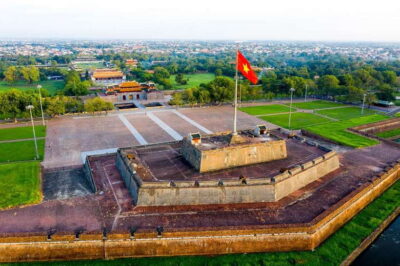
Next comes the Flag Tower, an architectural landmark within the south face area of the citadel. The guide explains how the royal court used this spot to signal with flags, so you understand it as part of official ceremony, not a random platform.
Cua Ngo Mon (Ngo Mon Gate)
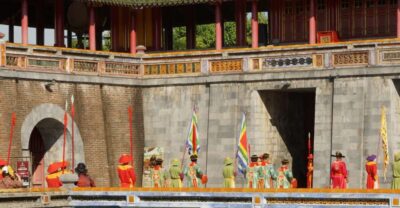
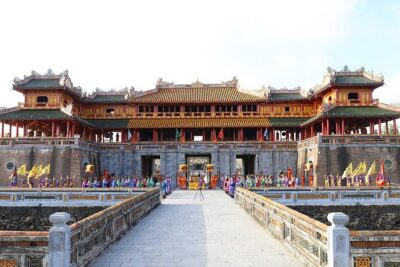
At the gate area (Cửa Ngô Môn / Ngo Mon zone), you’re in the ceremonial entry region. You’ll typically get guided time for photos and quick context, then move along.
The central palace sequence: Thái Hòa Palace and adjacent structures
One of the biggest reasons to do the guided version is what happens around Thái Hòa Palace (Điện Thái Hòa). This is the coronation palace site for 13 Nguyen kings, from Gia Long to Bao Dai. The guide helps you understand why a coronation space had to feel powerful and controlled. Even if you only spend minutes at the main hall view points, the explanation gives those minutes weight.
From there, you’ll pass through or stop near key buildings such as:
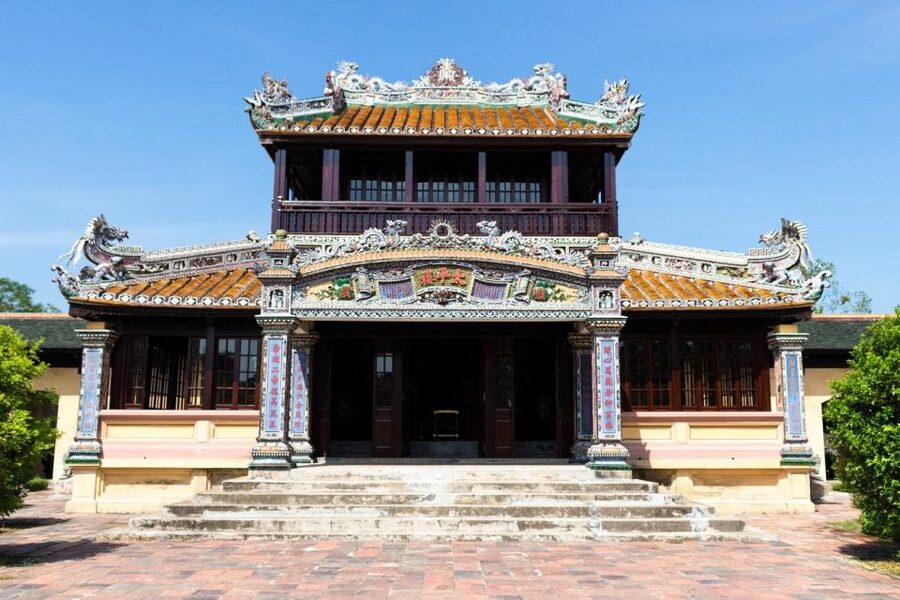
- Hien Lâm Pavilion: You’ll get orientation on what it’s for within the compound layout and how it fits the symmetry and movement of the court.
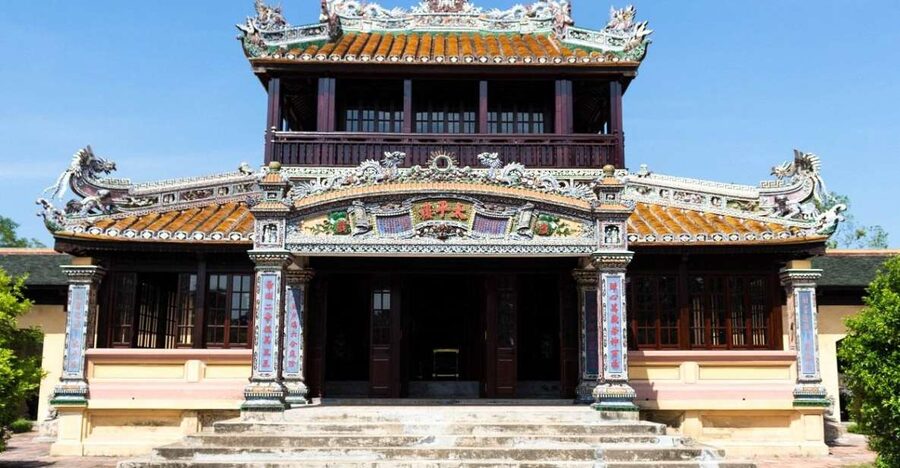
- Noon Gate (Ngọ Môn Huế): Built in 1833 under King Minh Mạng, it was used for troop movements and ceremonies. It’s one of those places that feels “just a gate” until someone explains how it functioned.
Nine Dynastic Urns and the Mieu Temple connection
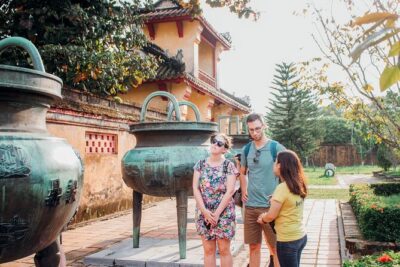
A standout stop for many people is the Nine Dynastic Urns (Cửu Đỉnh). These nine bronze urns were commissioned by Emperor Minh Mang in winter 1835 and inaugurated on March 1, 1837. They’re located in front of the Mieu Temple area in the imperial complex, which turns them from “cool metal objects” into part of an ancestor-and-state ritual system.
The guide usually ties this to the Mieu Temple (Thế Miếu), built in 1821 to worship 10 Nguyen kings. If you’re into how spiritual belief mixes with government in East Asia, this section gives you practical clarity without requiring a PhD.
Hưng Tổ Miếu and Hưng Miếu
The route then moves through additional ceremonial temple spaces—often explained as part of the imperial cult and dynastic continuity. You’ll usually get short guided segments plus time to look around.
Đại Nội (The Forbidden Inner Citadel / Inner Court area)
As you reach Đại Nội, you’re in the thick of the imperial administrative and symbolic core. This is where the tour often feels most satisfying for first-time visitors, because the guide connects the gate names and building positions into a coherent map of authority.
Hue Imperial City: time to slow down and look
You also get dedicated time for the Hue Imperial City section itself. This is where you can take in architecture, courtyard spacing, and the way the compound frames movement. Guides often use simple questions to keep you engaged, which helps when you’re walking in the heat.
Inside the Forbidden Purple City: where royal life stayed behind walls
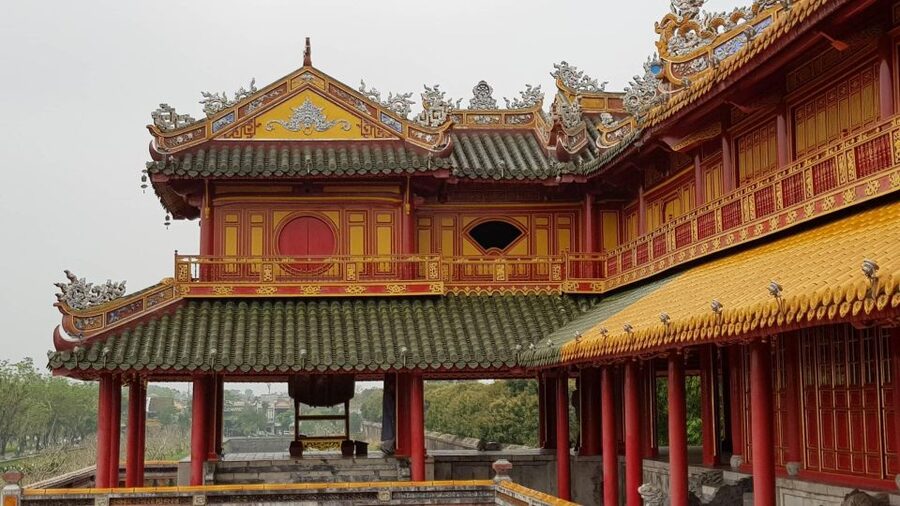
The walking tour typically ends your guided portion after the Forbidden Purple City area (Tử Cấm Thành). After your guide says goodbye, you can keep exploring on your own time if you want.
Forbidden Purple City (Tử Cấm Thành)
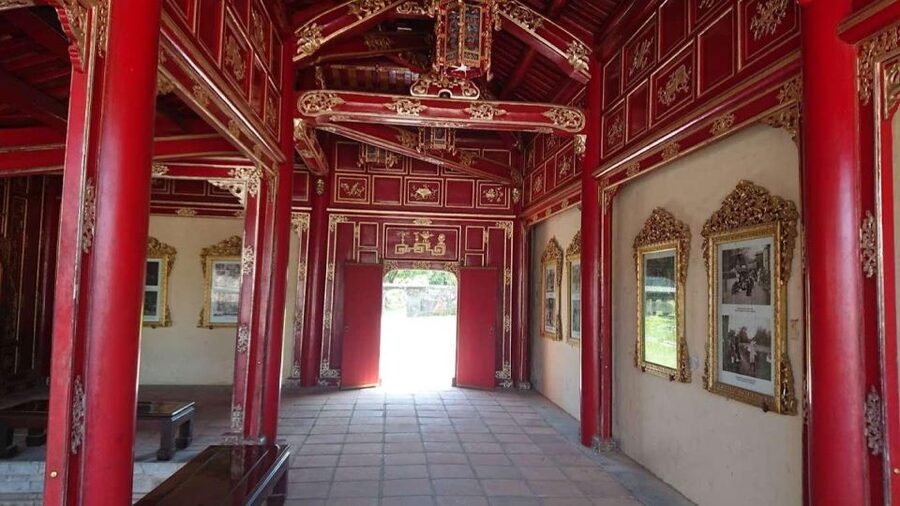
This is the heart of the restricted royal world. The guide explains that the Forbidden Purple City sits behind the Thái Hòa Palace. It was first built by King Gia Long (1804), then renamed in the third year of Minh Mang’s reign (1822). In practical terms, it’s also the part of the complex that makes everything you saw earlier click: the layout makes more sense once you picture who lived there and what daily life required behind the walls.
The later compound stops that round out the story
Your guided route may also include additional palaces, gardens, theaters, and pavilion areas, such as:
- Kiến Trung Palace
- Thái Bình Pavilion
- Thiệu Phương Garden
- Duyệt Thị Đường Royal Theater
- Triệu Tổ Miếu
- Cửa Hiển Nhơn
Even if you don’t catch every architectural term, you’ll generally come away with a stronger sense of how the compound balanced ceremony, performance, and family life under royal rules.
Private car options: build a full Hue day around emperors and pagodas
If you pick the private car version, you’re not stuck with one fixed walking circuit. An English-speaking driver meets you and takes you between highlights, and you can customize what you want to see.
A key detail: on the private car option, you get transport and a driver, but not an extra licensed tour guide. In other words, you’ll be driving by yourself and your driver helps with communication, while your depth of history depends on the spots you choose and what you decide to read or ask on-site.
Typical “best hits” you can combine include:
- Imperial City (so you can still cover the core royal complex)
- Thien Mu Pagoda
- Minh Mang Tomb
- Tự Đức Tomb
- Khải Định Tomb
- Thủy Tiên Abandoned Water Park
This is the format that fits you best if you’re juggling timings, want fewer stops, or prefer a slower pace between locations. It also works well if you’re traveling with someone who wants tomb time and someone else who wants more palace time.
Price and tickets: what the $12 gets you, and what to budget next
The base price is listed at $12 per person, which is hard to beat for the walking-guided experience inside the citadel area. But here’s the practical part: entrance tickets to the Imperial City complex are not included.
You’ll see an Imperial City ticket price listed separately (200k/adult). There are also combo ticket options for the Imperial City with tomb add-ons valid in two days:
- Imperial City + 2 tombs: 420k
- Imperial City + 3 tombs: 530k
So the value math is simple. If you’re doing mostly the citadel on foot, plan on paying the single-entry ticket plus any food. If you’re bundling tombs like Minh Mang, Tự Đức, and Khải Định, a combo can be smarter than buying one-off entries.
Also factor in time. The guided walking portion is about 2.5 hours on-site, so you’ll want comfy shoes and a plan for sun.
What to wear and how to pace it (so you enjoy it, not just survive it)
The citadel is outdoors for big chunks, and the tour includes plenty of walking between gates and palaces. Guides on the ground tend to protect the pace in real conditions—people have noted shade breaks on hot days and a calm approach when rain hits.
Here’s how to make the day feel easy:
- Wear shoes you can walk in for a couple of hours.
- Bring water and something light for sun (hat or scarf).
- If you’re sensitive to heat, consider starting earlier in the day when you can.
And if you’re the type who likes questions, this tour format rewards you. Many guides use back-and-forth explanation and make time to answer.
Guide impact: when the storytelling makes the buildings click
This kind of site can feel intimidating if you only get audio labels. One of the clearest strengths here is the quality of the guide experience, especially for the walking tour.
You’ll often hear names like Ha, Duy, Misa, and Nhien attached to standout sessions. The common thread is that guides explain not just what a place is, but why it was built. Some guides also connect structures to belief systems and ideas people associate with the royal worldview, including links between Confucianism, Feng shui, and Buddhism as part of how the compound was planned.
That approach matters because it gives you a way to read the space. After that, you stop seeing random courtyards and start seeing a designed system.
Should you book this Hue Customizable Tour?
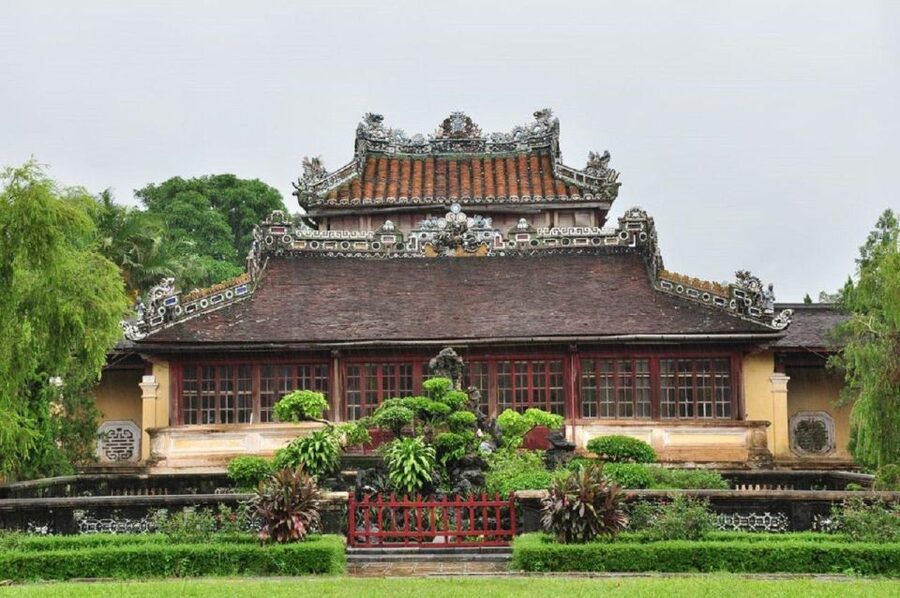
I’d book this if you want Hue’s imperial core to make sense quickly and you like history with clear direction. The walking option is especially worth it because you get guided time across the cannons, gates, main palace area, and the Forbidden Purple City zone, then you can wander afterward.
Skip it or adjust expectations if you want a purely independent day with no guidance. The private car option gives you transport and customization, but it won’t automatically replace the history and symbolism you get in the walking tour.
If your priorities are easy pacing, strong English-guided storytelling, and a practical way to see the big royal highlights in Hue, this is one of the more cost-effective ways to do it.
The Old Capital, Corner to Corner
- Hue :Exploring Royal City with Multi Options and Dragon Boat
★ 5.0 · 675 reviews - Hue City Tour Full Day – Group Tour
★ 4.7 · 518 reviews - Hue Imperial Ancient City Walking Tour
★ 4.8 · 308 reviews - From Da Nang/Hoian/Hue: Hue Imperial City Full-Day Tour
★ 4.8 · 295 reviews - Hue Imperial City Walking Tour: Citadel & Forbidden City
★ 4.8 · 245 reviews - Hue City Tour Full day – Small group tour
★ 4.7 · 137 reviews
More Tour Reviews in Hue Vietnam
- Hue :Exploring Royal City with Multi Options and Dragon Boat
★ 5.0 · 675 reviews - Hue City Tour Full Day – Group Tour
★ 4.7 · 518 reviews - From Hue: DMZ Tour with Vinh Moc Tunnels and Khe Sanh Base
★ 4.9 · 503 reviews - Hue: Private Car to Hoi An via Fabulous Stops
★ 5.0 · 371 reviews - From Hue: Hoi An Bus Transfer with 4 Sightseeing Stops
★ 4.6 · 366 reviews - Hue Imperial Ancient City Walking Tour
★ 4.8 · 308 reviews
Deeper Inside the Imperial Citadel
- Hue :Exploring Royal City with Multi Options and Dragon Boat
★ 5.0 · 675 reviews - Hue Imperial Ancient City Walking Tour
★ 4.8 · 308 reviews - From Da Nang/Hoian/Hue: Hue Imperial City Full-Day Tour
★ 4.8 · 295 reviews - Hue Imperial City Walking Tour: Citadel & Forbidden City
★ 4.8 · 245 reviews - Hue Imperial Citadel, Tombs, Perfume River Boat Tour & Van
★ 4.8 · 76 reviews - Hue Imperial City and Forbidden City Walking Private Tour
★ 4.9 · 42 reviews
Latest Hue Tours We Have Written Up






Imperial City & Citadel Tours, compared.
 ★ 5.0Imperial City Walk, Motorbike Tour & Private Car OptionsFrom $7732 reviews
 ★ 5.0Exploring Royal City with Multi Options and Dragon BoatFrom $12675 reviews
 ★ 4.8Hue Imperial Ancient City Walking TourFrom $2308 reviews
 ★ 4.8From Da Nang/Hoian/Hue: Hue Imperial City Full-Day TourFrom $31295 reviews
 ★ 5.0Hue Imperial City Walking Tour: Citadel & Forbidden CityFrom $9280 reviews
★ 4.8Hue Imperial City Walking Tour: Citadel & Forbidden CityFrom $11245 reviews
★ 5.0Hue Imperial City Walking Tour: Citadel & Forbidden CityFrom $9280 reviews
★ 4.8Hue Imperial City Walking Tour: Citadel & Forbidden CityFrom $11245 reviews
 ★ 5.0Hue Imperial City Walking Tour (Kids Half-Price)From $29133 reviews
 ★ 5.03-Hours Hue Imperial Walking Tour with Guide with Lunch/ DinnerFrom $30125 reviews
Browse the lists this tour appears in