
Reviewed · IMPERIAL CITY & CITADEL TOURS
Hue Walking Tour: Explore The Imperial City & Tour Guide
A royal city, explained at human pace. This Hue walking tour takes you through the key spaces of the Nguyễn Dynasty inside the Imperial City, with an English-speaking guide who helps you connect buildings to the people and rules behind them. You also get practical help getting started on-site, so you spend more time walking and less time figuring things out.
I especially like the strong, friendly English guidance. You may meet guides such as Austin, Ha, Duyen, or Sue Xuuuu, and their storytelling makes the complex feel navigable. I also like that the route is designed to fit a realistic time window of about 2 to 2.5 hours, hitting the big landmarks without turning it into an all-day marathon.
One consideration: the Imperial City ticket is not included (200,000 VND per person). It’s not a deal-breaker, but you should budget for it and be ready to pause for ticket time at the start.
In This Review
- Key highlights worth planning for
- Planning Your 2.5-Hour Hue Imperial City Walk
- Price and Logistics: $22 Plus the Imperial City Entry Fee
- Starting at Cua Ngan: Nine Holy Cannons and the Ticket Moment
- Ngọ Môn and Ngu Phụng Pavilion: Reading the Imperial Gate System
- Thai Hòa Palace and Duyệt Thị Đường Theater: Power as Architecture and Performance
- Kien Trung Palace and Dien Tho Palace: Contrasts Across Time, War, and Rebuilding
- Thieu Phương Garden and the Nine Dynastic Urns: Slower Sights That Stick
- Hien Lam Pavilion and the Mieu Temple: Memorials and Meaning in the Corners
- Timing Inside the Complex: How to Make Those 10 Minutes Count
- Who This Tour Is Best For (and Who Might Skip It)
- Should You Book Hue Walking Tour: Explore The Imperial City & Tour Guide?
- FAQ
- How long is the Hue Imperial City walking tour?
- Is the tour offered in the morning or afternoon?
- Do I need to buy an entrance ticket?
- Is bottled water included?
- Do you get pickup?
- Is the guide English-speaking?
- Is this a private tour?
- What main sites are included?
- Do you get a mobile ticket?
- How far in advance should I book?
- Is cancellation free?
Key highlights worth planning for
- English-speaking guides with a knack for making royal architecture make sense
- Flexible timing with morning or afternoon sessions, plus a walk length around 2 to 2.5 hours
- Orientation that saves time, including ticket help at the beginning
- Iconic stops like Ngọ Môn (Noon Gate) and Thai Hòa Palace, in a route that flows
- Small surprises across centuries, from cannon monuments to rebuilt structures and memorial pavilions
More time inside the Citadel walls
- Hue: Imperial City Walk, Motorbike Tour & Private Car Options★ 5.0 · 732 reviews
- Hue Imperial City Walking Tour (Kids Half-Price)★ 5.0 · 133 reviews
- 3-Hours Hue Imperial Walking Tour with Guide with Lunch/ Dinner★ 5.0 · 125 reviews
- Hue Imperial City Tip-Based Walking Tour (Group Tour)★ 5.0 · 59 reviews
Planning Your 2.5-Hour Hue Imperial City Walk
This is a walking tour built for focus, not for rushing. It runs about 2 hours 30 minutes (roughly 2 to 2.5 hours), and it’s offered in either the morning or afternoon, which matters in Hue when the light and heat can swing fast.
The tour is private in the sense that it’s just your group. That tends to make a difference here because the Imperial City is large, and a good guide helps you avoid wandering in circles. You’ll also get pickup offered, plus a mobile ticket. In practice, that usually means fewer logistics headaches once you arrive.
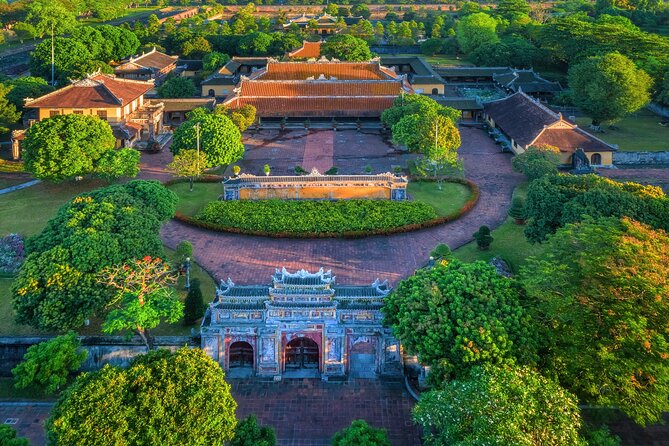
Where you start is inside the Imperial City area, and the first stop is at the Nine Holy Cannons in Cua Ngan (Cửa Ngăn). From there, the route moves through major architectural points—gates, palaces, pavilions, and a temple—so you’re not just looking at pretty walls. You’re tracing how power moved through space.
A quick practical note: this is still a walk inside an active historic complex. Wear comfortable shoes. Bring sunscreen if you’re going midday. And if you’re the type who likes to stop for photos, you’ll want to keep an eye on time—many stops are around 10 minutes, so you’ll get glimpses plus key explanations rather than a long sit-down at every building.
Price and Logistics: $22 Plus the Imperial City Entry Fee
The tour price is $22 per person, and that includes an English-speaking guide and bottled water. You also get features that reduce friction: pickup is offered, and you’ll have a mobile ticket.
But the Imperial City entrance ticket (200,000 VND per person) is not included. That’s the one line item you must plan for. Think of the $22 as paying for the guided route, timing, and interpretation—especially valuable in a complex where it’s easy to feel lost without context.
Is it good value? For most first-time visitors, yes, because the alternative is either self-guided wandering or hiring a guide later for only part of the site. Here, you’re guided through a structured set of key points in one compact block. Even if you still want extra independent time after the tour, having the “map in your head” afterward is worth a lot.
Also, the listing mentions group discounts, which can further improve value if you’re traveling with friends or family.
Starting at Cua Ngan: Nine Holy Cannons and the Ticket Moment
Most people think of the Hue Imperial City as palaces and gates. Starting at the Nine Holy Cannons (Cửu Vị Thần Công) flips that expectation in a good way. This is where you begin with power as something physical—defense, ceremony, and the presence of authority.
Your guide meets you at Cua Ngan and helps you with ticketing so the tour can start smoothly. That’s a subtle but useful point. Imperial sites can be confusing on arrival, and the tour is set up so you’re not stuck in line or trying to decode ticket rules while everyone else starts walking.
As you’re walking here, keep an eye on how the tour frames meaning rather than just describing facts. Cannons sound like military history, but in an imperial setting they’re also about status and control—part of the broader system of rulership you’ll see echoed in gates and palaces later.
Hue on foot, a handful more routes
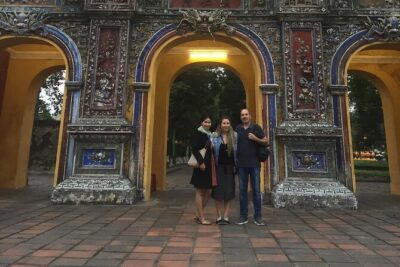
Ngọ Môn and Ngu Phụng Pavilion: Reading the Imperial Gate System
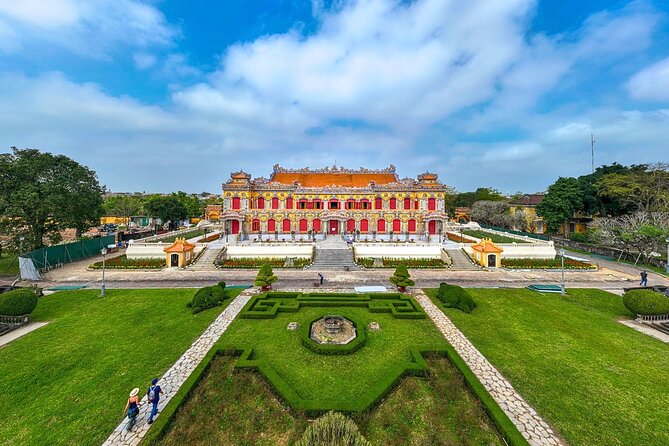
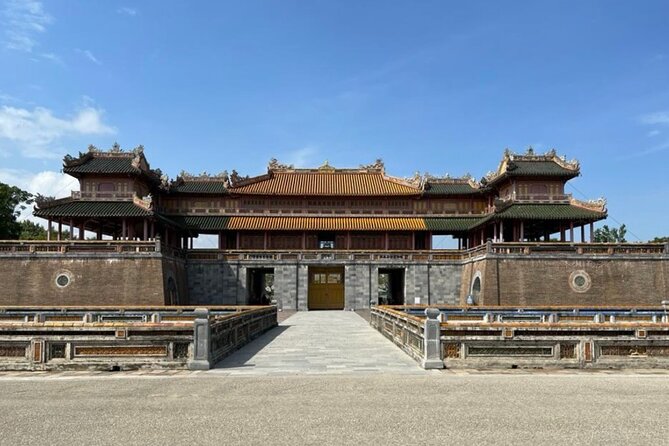
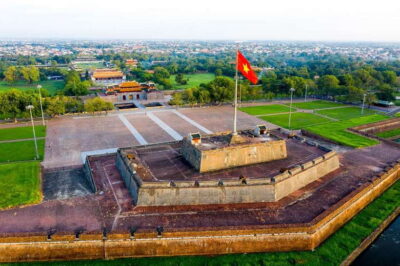
The route quickly moves to the center of the ceremonial layout. You’ll see the Flag Tower (Kỳ Đài Huế) and then the Noon Gate (Ngọ Môn Huế, also called the main Noon Gate).
The Flag Tower is a great example of Hue’s timeline in one structure:
- Built in 1807, about 30 meters tall
- Damaged by artillery
- Rebuilt in 1948 and now about 37 meters tall
That kind of detail matters. Without a guide, you might just see a tall tower and move on. With guidance, you start to understand that these buildings weren’t frozen in time. They were shaped by conflict and rebuilding.
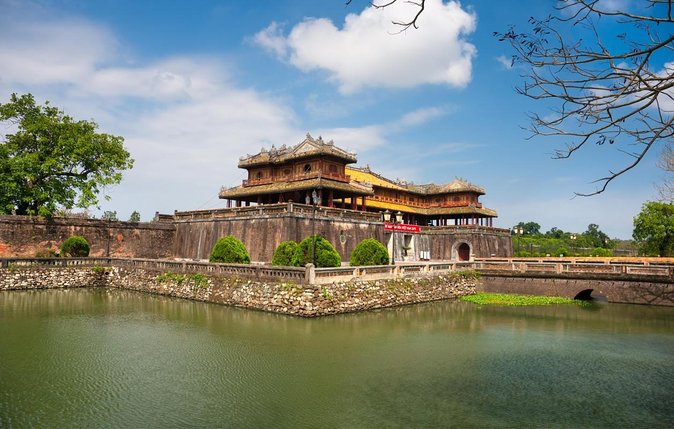
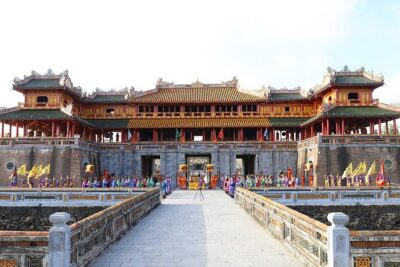
Then you reach Ngọ Môn (Noon Gate), built in 1833. The key point here is what makes it special: the entrance was only for the king. Standing at the gate, you’ll feel how rules of movement were built into the architecture.
Above the gate sits the Ngu Phụng Pavilion (Lầu Ngũ Phụng), and the materials are a story in themselves. It has an ironwood frame structure with 100 pillars. It’s the kind of feature that makes you slow down because it’s both elegant and highly engineered—exactly the balance imperial sites try to project.
Thai Hòa Palace and Duyệt Thị Đường Theater: Power as Architecture and Performance
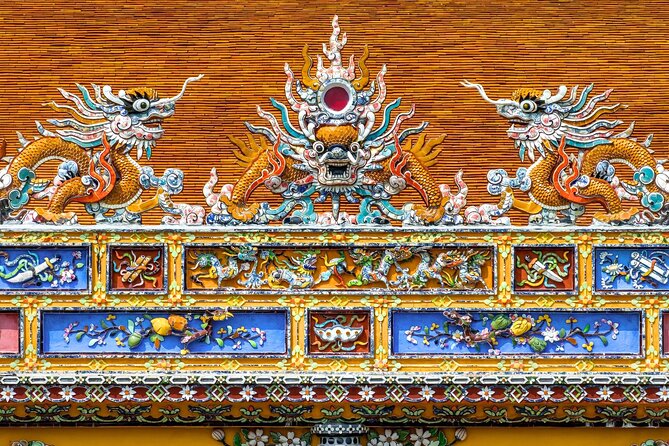
Next comes the heart of royal rule: the Supreme Harmony Palace, Thái Hòa Palace (Điện Thái Hòa). This is where the throne is located, and it’s described as the most important palace within the Hue Imperial. Even if you’ve seen palaces elsewhere, it helps to come here with a guide who explains what “main” means in an imperial layout.
Think of this stop as the tour’s anchor. The explanation tends to focus on how the throne room symbolizes authority and the structured nature of governance. You’re not just looking at a building—you’re seeing the centerpiece of the system.
Right after, you’ll visit the Duyệt Thị Đường Royal Theater (Duyet Thi Duong Royal Theater). This is an ancient theater inside the complex. The practical takeaway is that the architecture is royal in style, and there are still performances with royal acts. Even if you don’t time your visit for a show, it’s worth noting that this space isn’t only a display. It still connects to living tradition.
Kien Trung Palace and Dien Tho Palace: Contrasts Across Time, War, and Rebuilding
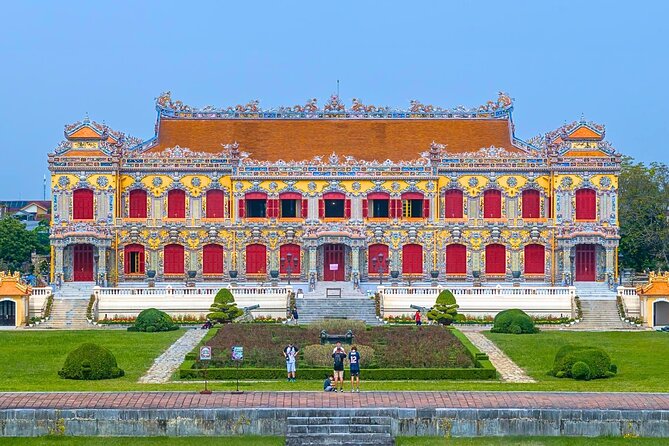
The tour includes two spots that feel very different from each other, and that contrast is useful.
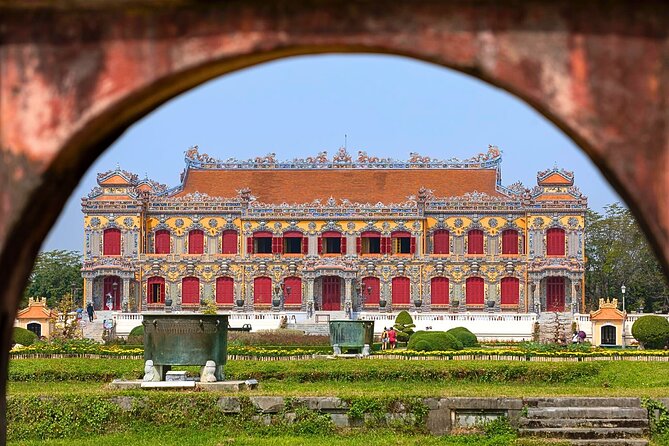
First is Kiến Trung Palace (Kien Trung Palace). It was built in 1923 with a mix of Asian and European architecture, which you won’t get from the more purely “traditional” imperial buildings. Then comes the history twist: it completely collapsed in 1947. In 2019, it was rebuilt, and it’s expected not to be completed until 2024.
That means you might see a structure that feels in-progress. If you’re the type who likes to understand how heritage changes under pressure, this stop is worth it. It shows that heritage is not always a clean museum photo—it can be restored step-by-step.
Then comes Dien Tho Palace (Cung Diên Thọ), built in 1804. This place was designed as a private area for the king’s mother. The key detail: it’s one of the buildings inside the Imperial City that remained intact during the war.
This pairing—Kien Trung’s collapse and rebuilding, then Dien Tho’s survival—gives you an honest sense of the site’s survival story. It also nudges your perspective. You start noticing how private spaces and public power spaces coexist, and you realize royal life wasn’t only about ceremonies at major gates.
Thieu Phương Garden and the Nine Dynastic Urns: Slower Sights That Stick
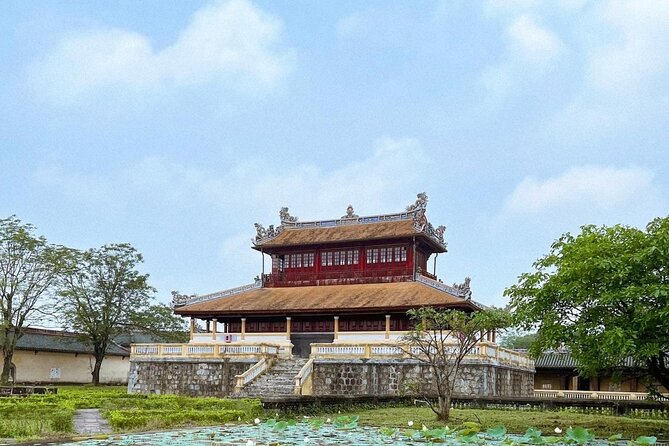
After the heavier power stops, the route turns toward quieter detail.
You’ll visit Thiệu Phương Garden (Thieu Phuong Garden), described as about 8,000 square meters and surrounded by gardens and brick walls. This is where the pace feels more forgiving. Gardens inside palaces often serve as breathing space and status symbols at the same time. With the guide’s context, it becomes easier to see why certain paths and walls were part of a controlled environment rather than just landscaping.
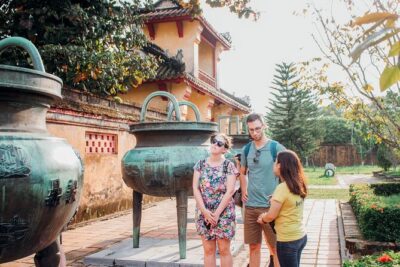
Then you’ll reach the Nine Dynastic Urns (Cửu Đỉnh Huế). These are unique bronze works from the reign of King Minh Mang. Each urn depicts images of Vietnam at that time, and there are 162 images across the set.
This is a stop you’ll either love or speed through—depending on how much time you give it. With a guide, you’ll be pointed toward what to look for, and you’ll likely leave with a better sense of how the empire visually recorded itself. Even if you can’t read every detail from a distance, the idea of 162 images turns the visit into more than a glance.
Hien Lam Pavilion and the Mieu Temple: Memorials and Meaning in the Corners
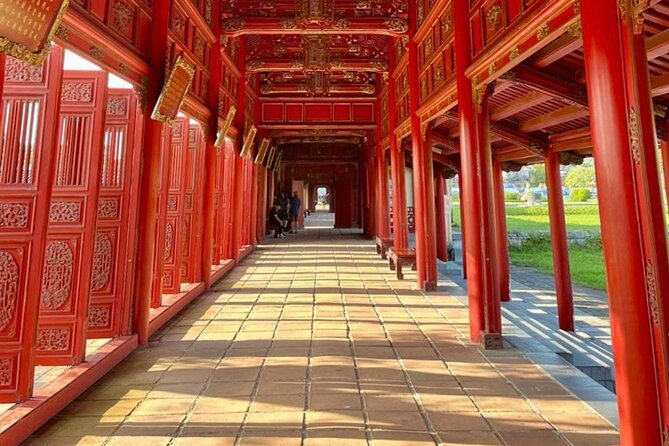
The tour also includes Hien Lam Pavilion, built between 1821 and 1822, a three-story structure with royal architecture. It’s described as a memorial remembering the merits of the Nguyễn kings. That description helps you treat the pavilion as more than an attractive viewpoint. It’s a designed place for remembrance.
There’s also a detailed architectural description connected to Hien Lam: it sits on a Bat Trang brick-tiled block with two stone staircases, each with 9 steps. The stair holders are decorated with dragon patterns. If you’re the kind of person who enjoys counting details, this is one of those moments where attention feels rewarded.
Finally, you’ll go to the To Mieu (often called The Mieu) temple, a shrine to the kings of the Nguyễn Dynasty. It’s located in the southwest corner of the Imperial Citadel.
This temple stop can feel small compared to the big palace spaces, but that’s exactly why it works. It adds a different emotional tone to the route—less throne-room spectacle and more reverence and remembrance. If you’ve been sweating through gates and platforms, the Mieu Temple gives you a quieter mental reset.
Timing Inside the Complex: How to Make Those 10 Minutes Count
Most stops are short—often around 10 minutes—so the tour is set up like a guided highlights reel. That doesn’t mean it’s shallow. It means you’re meant to walk away with clear anchors, then continue exploring on your own if you want more.
Here’s how you can make the most of it:
- Ask the guide one practical question at each major building, like what role it played in the imperial system.
- When you pause for photos, do it right at the point your guide mentions. That’s when the “meaning view” is easiest to capture.
- If you’re sensitive to heat, choose morning if you can. The difference in comfort can be huge.
Because the tour includes bottled water, you can stay focused instead of constantly hunting for drinks. Still, I’d bring your own if you know you drink a lot, since the tour only promises bottled water as included.
Who This Tour Is Best For (and Who Might Skip It)
This Hue Imperial City walking tour fits best if you:
- Want a guided route through the key royal landmarks without spending half the day navigating on your own
- Appreciate architecture explanations that connect gates, palaces, and memorials to the way the Nguyễn court worked
- Prefer an English-speaking guide with warm personality and clear storytelling (guides such as Austin, Ha, Duyen, and Sue Xuuuu are examples of what you could experience)
It might not be ideal if you:
- Already know the Imperial City well and mainly want long solo time with no structured stops
- Need lots of time inside each building’s interior, if the schedule feels too brisk for you
Should You Book Hue Walking Tour: Explore The Imperial City & Tour Guide?
Book it if you’re visiting Hue for the first time and want the Imperial City to feel understandable, not just big. The biggest win is the combination of a compact walk length, an English-speaking guide, and a route that hits gates, palaces, memorial spaces, and detailed artworks like the Nine Dynastic Urns.
Skip it (or pair it with extra self-guided time) if you know you’ll want to linger for long periods at each stop. The tour is efficient, and efficiency is the point. Also budget for the 200,000 VND Imperial City ticket, since that’s the one cost you’ll need beyond the $22 tour price.
FAQ
How long is the Hue Imperial City walking tour?
It lasts about 2 hours 30 minutes (roughly 2 to 2.5 hours).
Is the tour offered in the morning or afternoon?
Yes. Sessions are flexible for either morning or afternoon.
Do I need to buy an entrance ticket?
Yes. The Imperial City ticket costs 200,000 VND per person and is not included. Your guide helps you with ticket purchase at the start.
Is bottled water included?
Yes. Bottled water is included.
Do you get pickup?
Pickup is offered.
Is the guide English-speaking?
Yes. The tour includes an English-speaking guide.
Is this a private tour?
Yes. It’s private, meaning only your group participates.
What main sites are included?
You’ll visit highlights such as Nine Holy Cannons, the Flag Tower, Ngọ Môn (Noon Gate), Ngu Phụng Pavilion, Thái Hòa Palace, Duyệt Thị Đường theater, Kiến Trung Palace, Dien Tho Palace, Thiệu Phương Garden, Nine Dynastic Urns, Hien Lam Pavilion, and The Mieu temple.
Do you get a mobile ticket?
Yes, the tour includes a mobile ticket.
How far in advance should I book?
On average, it’s booked about 9 days in advance.
Is cancellation free?
Yes, you can cancel for free up to 24 hours in advance for a full refund.
The Old Capital on Foot
- Hue: Imperial City Walk, Motorbike Tour & Private Car Options
★ 5.0 · 732 reviews - Hue Imperial City Walking Tour: Citadel & Forbidden City
★ 5.0 · 280 reviews - Hue Imperial City Walking Tour (Kids Half-Price)
★ 5.0 · 133 reviews - 3-Hours Hue Imperial Walking Tour with Guide with Lunch/ Dinner
★ 5.0 · 125 reviews - Half-Day Guided Street Food Walking Tour at Hue
★ 5.0 · 116 reviews - Hue Imperial City Tip-Based Walking Tour (Group Tour)
★ 5.0 · 59 reviews
More Tour Reviews in Hue
- Hue to Hoi An ( Hoi An to Hue) Top Gear with Lefamily Riders Tours ( 1 way)
★ 5.0 · 3,156 reviews - Easy Rider private tour via Hai Van pass from Hue – Da Nang – Hoi An (1Way|Loop)
★ 5.0 · 1,542 reviews - Easy Rider From Hue Da Nang Hoi An Via Hai Van Pass With Mister T
★ 5.0 · 769 reviews - Hue to Dn/Hoi An: Hai Van Pass, beaches & Mt Monkey or vice versa
★ 5.0 · 743 reviews - Hue: Imperial City Walk, Motorbike Tour & Private Car Options
★ 5.0 · 732 reviews - Hue city Deluxe Group Tour (Daily Tour-12 pax max)
★ 5.0 · 569 reviews
Deeper Inside the Imperial Citadel
- Hue: Imperial City Walk, Motorbike Tour & Private Car Options
★ 5.0 · 732 reviews - Hue Imperial City Walking Tour: Citadel & Forbidden City
★ 5.0 · 280 reviews - Hue Imperial City Walking Tour (Kids Half-Price)
★ 5.0 · 133 reviews - 3-Hours Hue Imperial Walking Tour with Guide with Lunch/ Dinner
★ 5.0 · 125 reviews - Hue Imperial City Tip-Based Walking Tour (Group Tour)
★ 5.0 · 59 reviews - Hue Imperial City Walking Tour 2.5 Hours
★ 5.0 · 42 reviews
Latest Hue Tours We Have Written Up





Imperial City & Citadel Tours, compared.
 ★ 4.9Hue Customizable Tour with Imperial Citadel & Forbidden CityFrom $12937 reviews
 ★ 5.0Imperial City Walk, Motorbike Tour & Private Car OptionsFrom $7732 reviews
 ★ 5.0Exploring Royal City with Multi Options and Dragon BoatFrom $12675 reviews
 ★ 4.8Hue Imperial Ancient City Walking TourFrom $2308 reviews
 ★ 4.8From Da Nang/Hoian/Hue: Hue Imperial City Full-Day TourFrom $31295 reviews
 ★ 5.0Hue Imperial City Walking Tour: Citadel & Forbidden CityFrom $9280 reviews
★ 4.8Hue Imperial City Walking Tour: Citadel & Forbidden CityFrom $11245 reviews
★ 5.0Hue Imperial City Walking Tour: Citadel & Forbidden CityFrom $9280 reviews
★ 4.8Hue Imperial City Walking Tour: Citadel & Forbidden CityFrom $11245 reviews
 ★ 5.0Hue Imperial City Walking Tour (Kids Half-Price)From $29133 reviews
Browse the lists this tour appears in